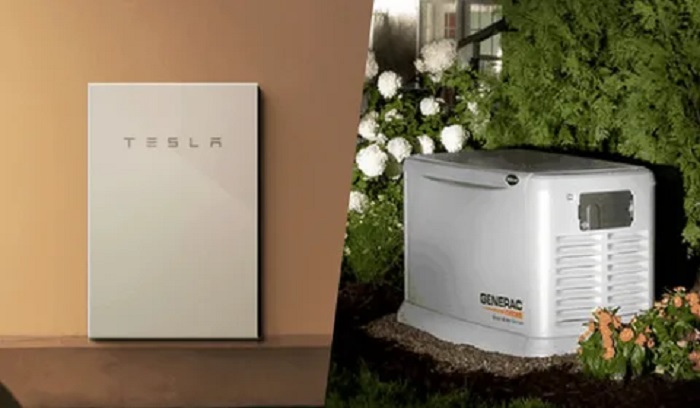
There are two common ways to keep a home powered when the grid goes down: store electricity in a battery or make electricity with a generator. Both can work. The better choice depends on outage length, fuel access, noise limits, maintenance tolerance, and how much automation the homeowner expects.
The comparison has become more relevant as outages stretch longer in some regions. According to the U.S. Energy Information Administration, average U.S. distribution interruption time in 2024 was 662.6 minutes per customer when major event days were included. A few hours of backup may be plenty for one household. Another may need a plan for overnight storms, wildfire shutoffs, or multi-day recovery.


How the Two Systems Think Differently
A generator creates power from fuel, usually gasoline, propane, natural gas, or diesel. A battery stores electricity that was charged earlier from solar panels, the grid, or sometimes another source. That difference shapes everything.
Generators are strong at long runtime if fuel keeps coming. Batteries are strong at instant, quiet power with no refueling during operation. Solar battery backup gets more interesting when paired with rooftop PV, because the solar array can recharge the battery during daylight if the system is designed to operate during an outage.
The Department of Energy explains that solar-plus-storage lets homeowners save solar power for later use, including when the grid is out. The key detail is system design. Ordinary grid-tied solar often shuts down during an outage for safety unless it has the right storage and isolation equipment.
Tradeoffs That Matter at Home
Noise is the obvious difference. A battery is nearly silent except for fans or relays. A generator has an engine. In dense neighborhoods, nighttime operation can be a real issue.
Maintenance is another. Generators need fuel management, oil changes, test runs, and attention to exhaust placement. Battery systems need professional installation and monitoring, but they do not need weekly fuel checks.
Then there is load behavior. A generator can often handle large motor loads if it is properly sized. A battery system must have enough inverter power, measured in kW, and enough stored energy, measured in kWh. Those terms matter: kW is the maximum power delivered at a moment; kWh is how much energy is available over time.
|
Question |
Battery backup |
Generator |
| Quiet operation? | Usually yes | Usually no |
| Needs fuel delivery? | No during use | Yes |
| Can recharge from solar? | Yes, if designed for it | Not directly |
| Best for multi-day runtime? | With solar and enough capacity | With steady fuel |
Why Hybrid Setups Are Becoming Common
Some homes and businesses do not choose one or the other. They use solar, storage, and a generator as a layered backup system. A battery can handle short outages and overnight essential loads. Solar can reduce battery drain during the day. A generator can serve as a final layer for unusually long events.
This hybrid thinking is common in microgrids, which NREL describes as local power systems that can disconnect from the grid and operate in island mode. In residential form, the same logic applies on a smaller scale: keep essential loads stable, use clean energy first, and reserve fuel for when it is actually needed.
ESYsunhome’s product range reflects those different backup levels. HM5 and HM6 fit basic single-phase residential storage. HM10, HM12, and three-phase HM systems fit higher-load homes. For larger or mixed-use sites, ES130-261 PV-Storage-Diesel Hybrid System pairs solar, storage, and diesel in one architecture.
A generator may still be the right answer for remote sites with limited solar or very long winter outages. A battery may be the better fit for homes that want quiet operation, solar self-use, and automatic short-term backup. The strongest plan is the one built around actual loads, not brand loyalty. For readers comparing integrated options, ESYsunhome’s solar battery backup systems provide a useful reference point.